First get big, then get profitable

The Rule of 40 was popularized as Brad Feld wrote about in 2015 (I would have guessed it was at least five years older, given how popular it is). He ends his post with:

I often hear – from sub-scale SaaS companies, “we can get profitable right away if we slow down our growth rate.” And – that’s often a true statement, but you will end up being sub-scale for a much longer time when you end up with a 20% growth rate and a 20% profit. So – if you are going to raise VC money, get focused on the T2D3 approach to get to scale, then start focusing on the 40% rule.

Brad Feld

T2D3 means annual revenue growth of 3x, 3x, 2x, 2x, 2x. A company with 1 million euro in revenue today would have 72 million euro in revenue after five years.

When taking VC money the strategy is to first get to scale, then get efficient (which the rule of 40 is a crude proxy for, and should be complemented with other metrics). The reason is that a high gross margin company at scale should be able to become very profitable. But a profitable company doesn’t necessarily become very big.
Two things make it slightly easier to raise capital: Being profitable or growing very fast

When raising capital a startup want to have multiple interested investors to create a competitive situation. Investors have different preferences, but I believe there are only two main groups:

  1. investors that invest in profitable companies
  2. investors that invest in very high revenue growth companies

Hence a company raising capital should either be profitable or grow very fast (or tell a story that makes it probable that it will grow very fast).

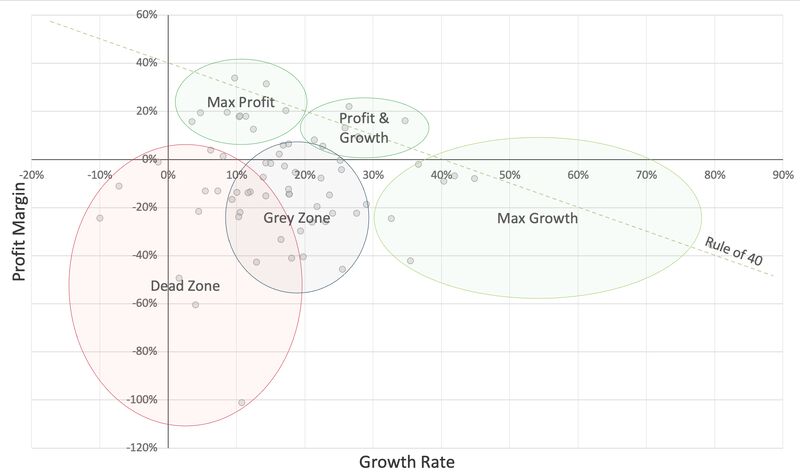
Todd Gardner captures it well, and in slightly more detail, in this graph.

(source: Todd Gardner)

However I believe that for seed stage startups the Max Growth circle should be much further to the right.

At seed stage and preferably Series A, revenue growth should be 100+ % year-over-year.

Only growing 30-40 % and being unprofitable is at best the Grey Zone and possible the Dead Zone.

Voi profitable in Q3’23

From VNV Global Q3’23 report

Today VNV Global reported Q3’23 earnings. One thing that caught my eye was that Voi was EBIT break-even in Q3.

There likely are financing costs (a.k.a. the Interest in Earnings Before Interest and Tax), but to have one of the leading Swedish startups of the last few years turn the corner to operating profitability is clearly positive.

And also worth noting the 30 percentage point improvement in one year, e.g. from ca -30% to ca 0% EBIT margin. There is a lot of operating leverage in digital companies.

Venture scale

One thing that founders should think about before raising capital is what outcome investors are looking for and how big that implies the startup ‘needs’ to become (and if the founders see some way to achieve that).

A great outcome for a small angel investor (and thus most founders) can be a company making €1 million in profit per year or an exit for €10-15 million.

That would not be true financial success for most venture capital funds, especially if they have invested several million euros.

To be a true financial success for venture investors a startup likely needs to reach €100 million in annual revenue and still be growing quickly.

That is the difference between building a really good company at smaller scale and building a venture scale company.

Are layoffs back?

In March I wrote I thought more layoffs would be coming to technology companies. So far that has been wrong, despite a weaker economy. Salesforce even started hiring again.

Likely a coincidence, but now both LinkedIn and Stack Overflow are cutting staff. But it is to early to say that technology companies are going back into layoff mode.

LinkedIn is cutting about 3% of staff, so it could be an annual performance culling/organization optimization more than significant layoffs.

Stack Overflow is cutting 28% of jobs, which is a significant. They seem to be more impacted by developers using AI than most, so it might be somewhat company specific. And the staff reduction follows some pretty quick hiring in the last few years.

Minecraft passes 300 million copies sold

Minecraft is, with some margin, the world’s most sold game as it has passed 300 million copies. Second place is held by GTA V with 185 million copies sold.

This is an example of a game that makes Stockholm a good place to build and invest in games. In particular I believe the success of Minecraft and Toca Boca, and before that Stardoll, make it more likely that the next 100 million user kids game or world will be built in Stockholm.

Three rules for investors on boards

The tagline of this blog, even if it doesn’t display on mobile, is It is simple but not easy. In that category I’d place these good points on being an investor and board member.

“Board members: CEOs want you to (a) stay calm and not panic: after all, you have a portfolio; the founder just has this one company, (b) show you care about the CEO and the company, not just about your investment, and (c) problem solve alongside the CEO, bringing your capabilities and resources to bear at company-defining moments instead of shying away from the moment and hanging the CEO out to dry.”

To behave that way is also the ambition of Alliance VC when we invest in startups.

Don’t aim to be profitable in 18 months

Given the lower amount of fundraising the last 1.5 years, there’s been a lot of focus among startups to become profitable. But for early-stage startups seeking venture funding I think it is the wrong focus.

Being profitable is a good thing, but it is a bad objective for a startup during the first few years. And it is not a great argument when raising pre-seed, seed or Series A funding. Capital efficiency is important, but investments in product and team will almost always mean cash and accounting losses.

The problem is that being marginally profitable doesn’t mean that you are making quick progress towards building a meaningful and large company. That leads to profitability in itself not being very value-creating, unless it is combined with revenue growth (which is by far the main driver of value, especially at seed).

For a startup it is always good to have a plan that takes the company, with some cost cutting, to break-even.1 That should be possible for many software startups from the combination of fixed costs for the team and (high gross margin) revenue. But it requires revenue growth, as cost cuts alone are rarely enough before you have tens of millions of euros in revenue.

I think the focus on capital efficiency is good, but a venture-backed startup on a reasonable track should not focus on becoming profitable. It should focus on making sure it is on a path to be fundable by improving the product, selling to more customers, dominating new market segments or geographies and making sure it solves important problems for its customers.

  1. Often it is enough to get to below €100,000 in monthly cash burn if you have institutional venture funds as major investors and are still growing at a reasonable pace. ↩︎

Having high expectations

The thing that elevates a startup ecosystem is individual startups that are highly successful. There’s no shame in failure, but it is startup success that drives progress as it brings in more highly skilled people, attracts capital and starts the next cycle of startups.

The Stockholm ecosystem is home to some seriously successful startups over the last ten years, with Spotify and Klarna in particular going from startups to large companies (in terms of revenue, employees and valuation).

But my sense is that Stockholm’s relative strength compared to other ecosystems, which led to the “most unicorns per capita outside Silicon Valley” mantra, is weakening.

I’m not sure exactly why that is, but momentum is extremely powerful both ways (positive and negative) so it is important to be ambitious and avoid negative momentum.

On a daily basis I think one good way to ensure that future startups are successful is to have high expectations on the startups, the founders and other actors in the ecosystem. The combination of a strong ecosystem and high expectations should continue to be a winning formula.