Lightbringer is looking for a CFO to join ahead of continued expansion. Perfect role for an experienced yet hungry CFO that wants to be central in building a great AI company from Malmö/Copenhagen/Öresund region.
Lightbringer is revolutionizing the patenting experience for innovators by combining the power of AI with extensive expertise in the patent industry to streamline and accelerate the patent process from beginning to end.
I find it interesting to hear skilled investors in other fields than venture discuss their approaches. Andrew Milgram invests in distressed assets, which is quite different from venture, but listening to his firms investments in things like taxi medallions in NYC is such an interesting listen.
Really good discussion on the niche of limited partners (investors in funds), the funding of venture capital funds, and funds making money and returning capital.
After a few weeks of vacation, it is great to be back in the office. This means reading pitch decks again, both from companies pitching Alliance VC and pitch decks made by companies we have invested in that will go out and raise in the fall.
I think good investors can (to some extent) ‘see through’ a poor pitch, but as a founder one should try to make a great pitch as a great pitch is extremely valuable due to the formula: good or great startup + great pitching = higher valuation. And it is a good thing that pitching (or presenting) a startup is something a CEO can get better at by training and making deliberate improvements to story and slides.
There is not one defined standard what a great pitch (or pitch deck is), but I find myself liking a lot of the advice on Pitchdoctor.
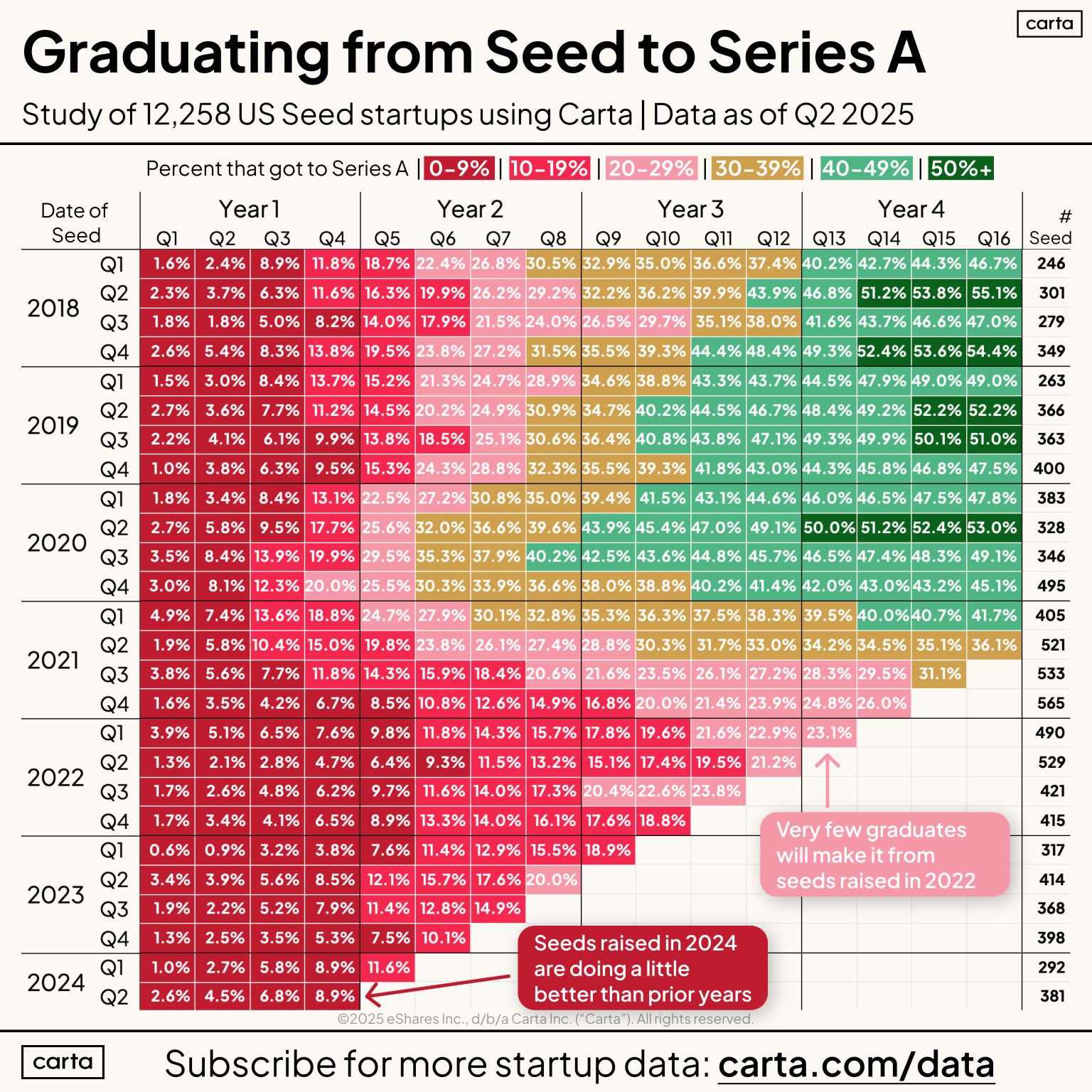
There are few data visualizations I like more than a good cohort chart and fundraising stats are an occupational hazard, so Carta’s seed to series A graduation cohort chart is the perfect content for me.
The chart show the % of startups that had raised a Series A by quarter following their seed raise.
In 2018 and 2019, before the craziness of the Covid times, about 10-14 % of startups had raised a Series A four quarters (one year) after the seed round and about 30 % after eight quarters (two years).
I look at eight quarters as startups traditionally raise about two years of cash. It is worth noting that about 50 % of companies had raised a Series A after 16 quarters (four years). The linear growth during years 3 and 4 surprised me a little.
For startups from 2020 and the first half of 2021 the graduation rates went up to 15-20 % after four quarters and towards 40 % raising a Series A after eight quarters (at least until Q1’21, then it started to drop).
For H2’21 until Q4’24 cohorts graduation rates were in the 4-8.5 % range after four quarters and 13-18 % after eight quarters (basically 50-60 % of 2018-2019 metrics).
While data is early, it seems like the graduation rates are increasing, as both Q1’24 and Q2’24 had 8.9 % graduation rates from seed to series A after four quarters. This is above 2022-2023 and 70-80 % of the 2018-2019 metrics.
It looks like a bottom has formed and that startups from 2024 have a more normal fundraising environment. This makes a lot of sense given the new generation of AI-driven startups that have been founded and raised capital.